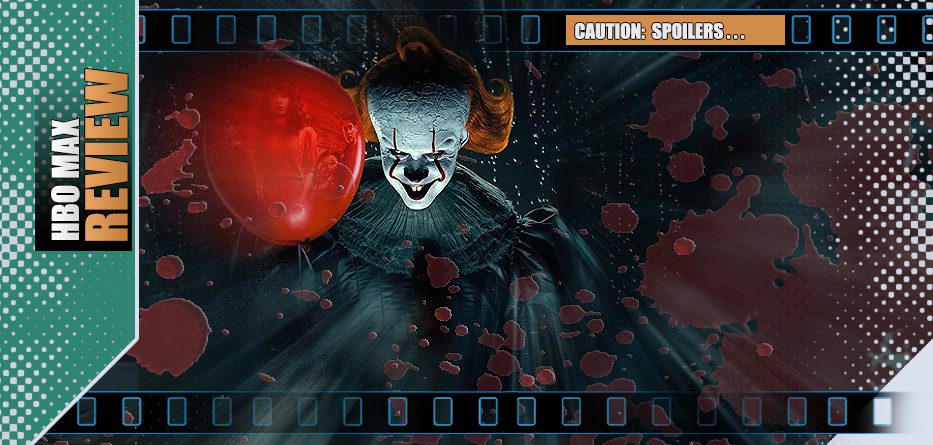
It’s 1962 and in the unbecoming town of Derry, Maine, the ‘business as usual’ maxim remains at odds with a strange, unsettling undercurrent that appears to have plagued the area for longer than many inhabitants can – or care to – remember.
Young Matty Clements becomes the latest child unable to escape the darkness that lurks within Derry’s borders and other children begin to experience visceral nightmares of their own. Major Leroy Hanlon, a soldier without fear, arrives at the local army base to face a Cold War test unlike any other…. as he and his family also encounter the kind of monsters that are, sadly, all too human…
*some spoilers*
UPDATE: In the first few episodes, Welcome to Derry seemed to have something of an identity crisis – to mix metaphors: each plate is spinning at a slightly different incline, each thread a differing texture, each personality within its malevolent matrix doing well in its particular tone, but also each vying for attention, making the sum of it uneven and sometimes hard to get a firm footing. It’s the kind of show where you can see where every dime and dollar has been spent and applaud what’s been done well, but still lament that some of the creative seams are showing… the kind of production where you can tell there’s been a push-me-pull-you of intent. Is it American Horror Story with a juvenile bent or a very ‘R’-rated Stranger Things ….the truth is it’s a little of both and not quite either.
 The Duffer Brothers’ original Stranger Things leaned in heavily and deliberately to the tone of some of Stephen King’s most celebrated stories, love-letters not just to the 1980s but to that timeless period of adolescence where kids must valiantly battle an innate evil that adults refuse to acknowledge. Part of the Netflix cult success was, at least initially, the sense of Stranger Things‘ dynamic nostalgia – the idea that those of us approaching middle-age (shut-up, get off my lawn etc!) loved the idea of reliving the pop culture and dreams of our youth. That series has got progressively darker (to varying degrees of success) ahead of the upcoming final burst of episodes (and the inevitable aging of its cast), but even at its Kate-Bush-embracing-best, it probably never considered the even stranger things that spring, crawl and drag themselves out of Hell and onto the screen for driving force Andy Muschietti and showrunners Jason Fuchs and Brad Kane’s efforts.
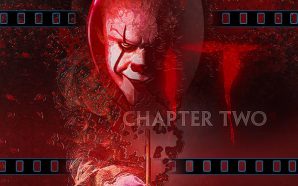
Yet another extension of the familiar source material and unapologetic connective tissue to accompany Muschietti’s glossy (if not ground-breaking) two-part feature film reboot of ‘IT’, it all feels ambitious but stretched and more than occasionally contradictory. Like Noah Hawley’s recent Alien: Earth, there’s a feeling that everyone’s glad to be allowed access to a legendary toy-box and rubbing their hands together on the possibilities, but that they can’t quite work out how to smash things together to produce anything beyond the sheer noise of that collision….
There’s several disparate threads here: a 1960s take on the Losers Club from the novels, the mystery of what lies near the local military base, the dangers of the evil force infecting the hearts and minds of Derry locals and the general feeling of still-evolving race-relations. Each element deserves their own space to breathe but even though the tapestry weaves together well by season’s end, it sometimes feel like they are competing for prominence.
The experiences of a black soldier in the army and the reaction within the local community is interesting territory and is reminiscent of how HBO‘s Watchmen also infused history and the shifting moral and social landscape into its more fantastical narrative.
Initially, Welcome to Derry felt confident and full of bravado – its smart title sequence underlies the idea of something rotten under the bland surface… We’ve been here before. Literally. This isn’t the first time that televisual creators have tried to flex the boundaries of King’s world. hulu brought us two seasons of Castle Rock which sought to bring in many narrative threads to a drama set in the infamous titular town, yet despite ambition and an impressive cast (including the likes of André Holland, Melanie Lynskey, Jane Levy, Sissy Spacek and, ironically a pre-Pennywise Bill Skarsgård) it never quite took hold as one might have expected. Welcome to Derry is to Castle Rock, what Torchwood was to Doctor Who and what Sinners was to The Vampire Diaries: a genre embracing the core basics but then going wild on crack.
Like Stranger Things, the young cast are a major factor in the show’s success. Clara Stack as the troubled Lilly Bainbridge has some great moments, Blake Cameron James as Will Hanlon is good, Matilda Lawler pivots nicely as Marge Truman and Amanda Christine impresses as Ronnie Grogan. Particularly in later episodes Arian S. Cartaya as Rich Santos excels. Among the adult cast-members, Jovan Adepo as Leroy Hanlon, Stephen Rider as Hank Grogan; veteran James Remar as General Francis Shaw bring their A-game and it’s great to see Madeleine Stowe (as Ingrid Kersh) making a real impact after time away from the screen.
It’s true that Pennywise, the Deadlights and the entire IT mythology exist on the power of weaponising primal fears to the extent that characters and the audience can never be sure what’s actually happening and what’s merely being conjured up to power-up the batteries of dread. One of the earliest scenes in the first episode features a haunted car and a sequence that can only be described as the birthing sequence from Hell. Little is left to the imagination. Yes, those unearthly visions are meant to be uncomfortable and make you uneasy, but this in particular also feels like a bloodiest, most graphic moment in there for pure shock value, something specifically designed to get the critics chirping and the water-cooler bubbling as if the river Styx itself had decided to boil. To that extent it obviously works, but in doing so it somewhat overplays its hand, adding very little to what could have arguably been done with more suspense and inference rather than in-‘yer-face, on-the-nose embryonic evil goo. King’s strengths were in producing dark magic from the daylight of the mundane, but in going in so heavily on nightmare visions at the start and making them the show’s punctuation (A Nightmare on Elm Street being another touchstone), Derry… initially risks misunderstanding the cause and effect. Instead of audiences reveling in the tension and the relief when the wave breaks, it’s more a case of rubbing their faces in the tsunami of an ‘ewwww‘ factor… and that can be a law of diminishing returns. Again, thankfully the show works out that kink as we progress.
I said near the start of broadcast that Welcome to Derry would ultimately be judged in its entirety, or at least at the end of a season and it’s good news that, as it went along, the show levelled out and managed to bring the scares and emotional development. Some of the Pennywise images were shocking and sometimes pretty explicit, but there wasn’t the sense of it merely trying to ‘out-do’ the graphic imagery of the pilot episode.
For something that’s a period piece being made by those fully-invested in King-lore (Shawshank Prison gets a nod and the character of Dick Hallorann, originally played by Scatman Crothers in Kubrick’s version of The Shining, turns up here played by Chris Chalk – who handles the weight skillfully) there’s also some surprising lapses. There’s nods, winks and easter eggs for the King faithful, though some discrepancies or fault-lines. A key-part of the opener sees a film screening gone askew (imagine Doctor Who’s LUX done on a bigger budget and designed for a far older audience), with the missing Matty emerging from the screen that’s otherwise The Music Man… only that film wasn’t out for a full three months after the very-specific April 1962 setting. How much such details bother you will vary, but one cannot expect to be praised for the minutiae but be given a pass on prominent factors as well.
Given it is a period-piece, yet another extension of the familiar source material and unapologetic connective tissue to accompany Muschietti’s glossy (if not ground-breaking) two-part feature film reboot of ‘IT‘, it all feels ambitious but stretched. Like Noah Hawley’s recent Alien: Earth, there’s a feeling that everyone’s glad to be allowed access to a legendary toy-box and rubbing their hands together on the possibilities, but early episodes sometimes feel like smashing things together to produce noise. That gets better as the direction settles in and you begin to see how various pieces legitimately fit together. Muschietti’s mission statement is ultimately not just self-service to his own movies but to flesh out and explore the smaller, less detailed corners of the original novel.
Despite the promotional imagery, Fuchs and friends decided to keep their central clown car in reserve, with a Pennywise vibe permeating the early episodes, but with little direct sign of the clown himself. The showrunners suggested ‘less being more until more is more‘ as we progress through the season and by season’s end the figure of Pennywise is not just featured but expanded, allowing Bill Skarsgård to be more than just the blood-drenched clown. We see the ‘original’ Pennywise before the alien force took his shape and arguably learn more about the malevolent force than we’ve done in all the films to date.
There’s definitely been enough here to keep audiences watching and much talk of grander plans to expand the concept in both directions along the timeline (*spoiler* things could get complicated if a second season, as likely, goes forward, but the narrative goes backwards).
New episodes of Welcome to Derry are released on HBO Max every Sunday…
- Story8
- Acting9
- Direction9
- Production Design/VFX9