There’s been a lot of anticipation about Noah Hawley’s series Alien: Earth but also some trepidation about the very idea of bringing the big-screen’s most infamously ravenous extraterrestrials to the living room on a weekly basis. After all, the franchise itself has become something of an acidic rinse and repeat, making some concerned that short of retreading old ground, there’s a limit at what can be seen as new and effective.
The first film, directed – of course – by Ridley Scott, was released in 1979 and is an undeniable stone-cold classic not just of sci-fi but for cinema itself, fondly-remembered and more than capable than standing up to repeat watching. The 1986 sequel, Aliens, saw James Cameron reinventing the idea by expanding the scope in both story and number of xenomorphs. But thereafter, few directors have done anything as substantial with the franchise. A mixture of strange, capable and decent, many follows-up were merely slight variations on a theme – changing faces and locale with the helmsmen demonstrating shifting styles but still ultimately interchangeable. The off-shoot of the Alien Vs Predator films promised something a bit different, but ultimately what ended up on screen were more guilty-pleasure monster-mashes with thrills rather than chills.
So, what’s the deal with doing a tv series, albeit a non-network show so that it’s not simply an IP for generic family-fun? The streaming option has opened up a lot of possibilities in the last few years and there’s a solid argument that now is the time to do risky, edgy and for-mature-audiences drama like never before. But intention and result can differ, so is Alien: Earth all it can be?
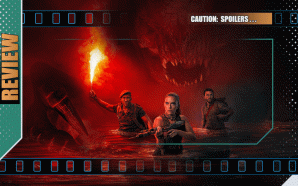
The first two episodes arrived for streaming audiences this week (the broadcast shared between FX and hulu in the US on 12th August and Disney+ in other territories a day later). The first hour is essentially a scene-setter and suffers slightly from what audiences might expect vs. the newer world-building that will be necessary to sustain a series. Yes, the very first scenes of opener ‘Neverland‘ unapologetically echo Scott’s original set-up, to the extent that one wonders if the sets had been pulled out of storage or if we’d be getting a carbon copy. This might be a ‘new’ ship, the Maginot, but for all intents and purposes, this is the production department’s faithful rebuild of the Nostromo, avoiding the age-old problem of having better VFX and designs for something made after but ironically set before something that narratively predates it. The low-light sleeping pods, the communal eating area and computer interfaces all exist with a familiar hum and even the assorted miscreant crew feel like John Hurt should appear and be complaining about indigestion at any moment. But here, the show is surprisingly selective about what it shows and what it tells: in truth – visuals aside – it’s almost everything BUT the main event we expected and which the recent Romulus traded upon. For Alien: Earth the crew have already visited some alien worlds off-camera and retrieved a variety of dangerous specimens – not just the face-hugging variety of old. However, there’s still the air of distrust and imminent danger (accentuated, perhaps a little too much, by Hawley flash-cutting scenes of future chaos like subliminal portents). It’s clear that the ship’s resident cyborg, Morrow (Babou Ceesay), is just as untrustworthy and has a ‘specimens survive over crew’ mandate that we’ve become so familiar with over the decades. We don’t see, except in those subliminal-flashes, when exactly things went wrong or the crew fighting, vainly, for survival. We do see Morrow essentially sacrifice a fellow crew-mate before the ship crashes, literally, to Earth and learn thereafter that though he survives (as do the alien specimens), the humans onboard were dead, digested or torn apart long before that impact. It’s like cliffhangers as cliff-notes.
There’s a feeling after the first two episodes that the show doesn’t quite have its core as yet, having so many ideas that the show’s title itself is open to question…. is this a show about the familiar Alien threat with simply time and space for more decoration, or is that simply a maguffin for broader concepts to hang upon like meat in a charnel house? A little like Westworld, there’s an appreciation and sense of wonder in the ambition of it all… but also a question as to whether it is trying to be too profound in the face of actually needing to be consistently entertaining…
But there’s also another thread of the story competing for time until the two converge. Hawley’s story for the series is as much about the powerplays on Earth. As explained, Weyland-Yutani control North and South America, with a total of five major corporations strategically competing with each other for dominance across the globe in a way that suggests they’ve watched way too much Game of Thrones and Westworld in their downtime, maybe even with a touch of The Penguin with its opportunistic betrayals. We’re introduced to one of the heads of such empires, founder and CEO of the Prodigy Corporation Boy Kavalier (Samuel Blenkin) who looks like a young Tom Baker and acts like an even more adolescent Elon Musk. He has his own nation and an island base he calls Neverland – hence the episode’s title – and there’s plenty of ongoing Peter Pan references. Attempting to upset the use of ye olde cyborgs to do grunt work and even Synths (artificial intelligent beings), he’s been experimenting with moving actual human consciousness into artificial bodies to create Hybrids. The first ‘recipient’ of the operation is a young girl, Marcy, who has terminal cancer (initially played by Florence Bensberg and then by series-lead Sydney Chandler) and it would seem that the new Marcy-now-Wendy’s existence is likely a forerunner for a kind of immortal warrior used to protect desired corporation assets as much as Earth’s population. Her only existing family pre-op is a brother called Hermit (no, really) played by Andor‘s Alex Lawther, who now think she’s dead and she can have no further contact with him. Her transition is successful and leads to a team of other kids being transplanted (the notion that though there may be some emotional cues to deal with, young minds handle the shift far better than adults that resist the change). Keeping to a theme, they are all given new names that reflect the ‘Lost Boys‘ of the J M Barrie classic.
When the now terminally-hobbled Maginot crashes through the atmosphere and into the heart of Siam City and the heart of Prodigy’s domain, Wendy realises that Hermit is one of the medics on-site and persuades Kavalier that this ‘rescue-mission’ would be a great way to test her and the hybrid team. Reluctantly he agrees, sending them with Kirsh, the cyborg/synth who runs the Hybrid program, to do damage control (and, more, importantly to him, to confiscate any useful Weyland-Yutami tech that can be salvaged for Prodigy), But no-one is quite ready for the truth about what has survived the crash…
The casting is spot-on. There’s quite a large ensemble, but even (so far) minor characters seem to have weight and potential importance – though there’s already a huge amount of human collateral damage. Sydney Chandler makes a compelling central character but is sufficiently different from the Ripley-esque figures that have dominated the franchise, keeping a sense of sheer wonder and naivety in the eyes that reflect the character’s inner-age. Blenkin’s Kavalier is instantly dislikeable in a good way, showing all the spoilt, bored intensities that only trillions of dollars can buy. Ceesay’s Morrow feels genuinely duplicitous and dangerous. Between moments of legitimate panic and sorrow, Lawther gives Hermit a quiet bravery, surviving several encounters in unlikely ways, likely making him one of the luckiest characters bar Ripley the franchise has produced. Kirsh is played by Timothy Olyphant, arguably the biggest name attached to the project and Kirsh’s pragmatic approach to the project and its missions make him an interesting and pivotal ‘supporting character’, the rudder by which many of the ‘Lost Boy’s steer their fates. Australian actor Essie Davis plays Kavalier’s other advisor, half underling, half mother-figure and the more emotive heart of the operation, still driven by some idealism. It should be noted that I was totally oblivious that Kavalier’s henchman and dour right-hand man Atom Eins is played by no less than The Young Ones‘ Adrian Edmonson, light-years away from his normal larger-than-life characters.
The production designs, as mentioned, are great, but also show diversity. Beyond the other dangerous specimens (can we have a collective ‘ewwwwwwwwwww‘), spaceships and cityscapes there’s certainly attention to other details as we go about world-building. I’m not sure I totally bought into the arrogant ‘Regency’ party that continues through the building’s destruction, but the sight (and mostly sound) of a xenomorph cutting through those powder-puffed guests and the immediate aftermath is quite the moment. The use of ‘old’ cultural images has always been a sci-fi lean (I remember Mr. Garabaldi was a huge Looney Tunes fan in Babylon 5) so we’ll have to see if the use of not just Peter Pan but repeated Ice Age footage and references also proves relevant as we go on. The VFX vary from great to okay, often with an emphasis on stylistic touches. I felt a little disappointed by the Maginot‘s crash sequence and some xenomorph shots work better than others and they’re better when the figure is in motion.
Hawley’s choices seem entirely deliberate and it may be down to the subjective viewer as to which decisions work best and which leave us frustrated. There’s a feeling after the first two episodes that the show doesn’t quite have its core as yet, having so many ideas that the show’s title itself is open to question…. is this a show about the familiar Alien threat with simply time and space for more decoration, or is that simply a maguffin for broader concepts to hang upon like meat in a charnel house? A little like Westworld, there’s an appreciation and sense of wonder in the ambition of it all… but also a question as to whether it is trying to be too profound in the face of actually needing to be consistently entertaining.
By the end of the first two eps, there’s certainly enough to enjoy and maintain interest and to keep you wanting more, but it’s still a little uncertain about how we’ll proceed overt the total of eight episodes in this first-run. (There’s no official greenlight on a second season, though it seems a foregone conclusion). The Alien-part of the DNA feels more like stretching out the beats we already know and perhaps by necessity, the xenomorph(s) feels more cautious than previous outings, often strategically hiding in the shadows and letting people pass by, even if the attacks – when they do come – are just as violent. I’m still not sure how many xenomorphs they are, whether their capabilities are mythologically-consistent or the status of the other beasties, but one presumes this will be addressed as we move forward. So far, the ‘Hybrid’ aspect feels like a parallel story a la Blade Runner, rather than a fully integrated one. The kids-in-adult-bodies could have been a potentially problematic narrative choice and minefield, though it’s a tribute to the actors that rather than having a ‘Teen Force Alien’ ripe for animated Saturday morning serials, we’re consistently reminded that we are viewing a Mature Audiences story where the fact that the characters are genetically-displaced children (with all the awkwardness and immaturity that entails) is important but technically incidental to the their ‘owners’ as they face undiluted peril. Of course, that often makes us wonder about the veracity and wisdom of sending them into dangerous situations when learned strategy and experience may mean just as much as being stronger and faster than humans, but it’s made clear that the only reason Boy Kavalier might spend time on that thought is the production costs involved.
I have no doubt that Ridley Scott will love it. The rest of us… we’ll see. Early reviews suggested it would do for Alien what the quite brilliant and nuanced Andor did for Star Wars but, as yet, I’m not entirely convinced that’s a benchmark it’s reaching… yet there’s the possibility it will as all the ingredients are here…
- Story8
- Acting9
- Direction9
- Production Design / VFX9