A battered and bruised Man of Steel finds a temporary solace from the heat of a battle, thankfully close enough to his Fortress of Solitude to get back there to recuperate – all with a little help from a four-legged friend. But these are just the start of Superman’s problems as his other recent actions, stepping between opposing forces on a battlefield proves that no good deed goes unpunished.
Billionaire Lex Luthor genuinely doesn’t believe that Superman’s presence makes the world a better place and he’s using every means at his disposal to turn the world against its premiere alien metahuman. He’ll stop at nothing to bring Superman to his knees, but when he discovers a secret about Superman that isn’t yet known to the last survivor of Kryptonite himself, he may finally have a way to do that, separating him from his friends and losing the trust from those he protects…
*spoilers*
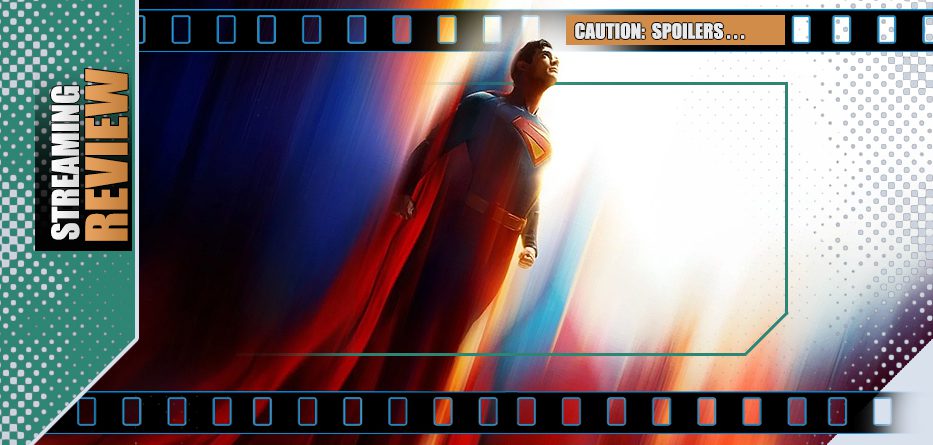
Well, even by ‘faster than a speeding bullet‘ standards, that was quick. With its celebratory popcorn buckets still fresh in multiplexes, James Gunn’s Superman is now arriving on streaming platforms… a significant move likely popular with those who haven’t managed to get to a multiplex, but likely to frustrate those self-same cinemas who’ll despair at the potential dip in their takings (a complaint we’ll probably hear more about if this continues to be a pattern).
Even as it sought to escape the darker and more nihilistic tone of Zack Snyder’s version of Superman and drag the Man of Steel into a more sunlight-friendly tone that could repower him and the franchise, there was the danger that such an enforced course-correction could still be little more than a cash-grab nostalgia-fest. As recently as this week, just days just before release, there were conflicting camps and thoughts about James Gunn’s reboot of the Superman franchise for Warners/DC. Contradictory reviews stated it was either a rousing triumph or a confused mess. The truth is that there’s some of both elements in the result. What the film does well, it does well indeed, but where it misses its target it does so by aiming wildly. Gunn’s characters and casting are spot-on, almost historically great with the chemistry to match. But the story in which they feature is more uneven, sometimes inspiring, sometimes a complete and crowded maelstrom.
It would seem an impossible task to both embrace the old-fashioned optimism and Boy Scout status of DC Comics‘ icon and to place the square-jawed hero into an all-too-topical minefield of international politics and diplomacy, but to his credit, Gunn manages to do so, albeit by ultimately playing lip-service to the latter and using it to provide guard-rails.
The uneven conflict between the fictional countries of Boravia and Jarhanpur is one that Lex Luthor frames to his advantage, using Superman’s erstwhile intervention to stop loss of life (that initially happens off-screen, before the film starts) to raise the spectre of an almost unstoppable superhero (or ‘metahuman’) affecting the world stage without control or global consent. That in itself is fertile territory if you wished to explore it. You also don’t have to read too deeply to see the Russia/Ukraine or Israel/Gaza metaphors. However, Gunn himself is also using it for his own convenience rather than a nuanced narrative that frames the wider film. Unlike comic-book writers such as Mark Millar or Frank Miller who would unapologetically deep-dive the high-concept with glee (and which Zack Snyder would embrace) Gunn uses it as temporary imperative and the bigger (arguably valid) question that Luthor offers up as an excuse is eventually lost to the villain’s more cackling machinations. If anything, Gunn’s conclusions and observations about fluid morality is that the public’s perceptions are pliable and fickle at best.
CGI decoration is obligatory and not just in the sense of Superman’s dog Krypto – a creation that could be stupid and distracting but is, for the most part, a great deal of fun. The set-pieces battles are big and brash, though noticeably Gunn makes a point of using the real-estate carnage to illustrate Superman’s eagerness to save everyone he can – an element that Snyder often casually ignored (excepting one rather brutal death of a brave innocent here that tonally feels ‘off’ rather than dramatic). If the story veers between those set-pieces, the other bullet in Gunn’s arsenal is his casting, which is mostly spot-on and should be applauded.
Ignore the ridiculous hand-wringing from some quarters with claims about the film being ‘woke’ – anyone who frets about such things clearly isn’t familiar with the generational raison d’être of Superman. What Gunn does gives us – in a messy but enjoyable summer romp of a blockbuster – that is not always logical but mostly entertaining – is heart and steel and a not-so-subtle Silver Age reminder of our better angels at a time when the real world seems determined to ignore them…
While Christoper Reeve remains the iconic benchmark by a considerable margin, David Corenswet quickly becomes both a Superman and Clark Kent for the ages, excelling in the difficult task of playing into both the young man who initially and instinctively (if sometimes also naively) sees the best of every situation and every person, yet also the physical warrior able to be the fist behind the benevolent glove. There’s long been the observation about the character and concept that Superman/Kal-El is the real person and Clark Kent is the secret identity (rather than the reversed Bruce Wayne/Batman dynamic) and as a performer Corenswet is able to shift his gait and stance in a similar way to Reeve and play to the strengths of both.
The Marvelous Mrs. Maisel‘s Rachel Brosnahan as Lois Lane is also impeccable, given the role the requisite sparkle and sass and is great every moment she’s on-screen. However, while never succumbing to the mere ‘damsel-in-distress’ she’s not used quite enough, often there more to bring out the ‘human’ side to the titular character than to affect the plot. But she manages all the CGI swirling around her with aplomb and the chemistry she shares with Corenswet is obvious and is the beating heart of the film.
Nicholas Hoult as Lex Luthor gives it his all, also great in what he delivers but whose age sometimes plays against him. There’s a cynicism that the character consistently channels… while it plays to wider scheming, there’s his genuine layer to his vanity that perceives a danger that an alien force like Superman could bring to the world order and his own status, that seems better territory of an older, more weathered man. But while Hoult has both the flicker of the ego and sardonic tone of Gene Hackman’s incarnation, he embraces the darker aspects of the role and is never less than earnest.
The supporting cast, collectively too big for the over-packed movie, are all good individually. Skyler Gisondo has some fun with his Jimmy Olsen and Sara Sampaio’s Eve Teschmacher has more to do than you’d expect at the outset. Neva Howell as Martha Kent and Pruitt Taylor Vince as Jonathan Kent impressively make the most of their screentime and grounding Clark through the otherwise unseen upbringing in a way that the film needs given its decision to not replay that origin story once more. Nathan Fillion as the cocky Green Lantern, Guy Gardner is fun, The Last of Us‘ Isabela Merced is a fun Hawkgirl and Edi Gathegi’s terrific turn as Mr. Terrific makes us for the poor use of his talents back in X-Men: First Class. There’s also Frank Grillo, Wendell Pierce and appearances from Bradley Cooper and Angela Sarafyan as Supe’s Kryptonian parents (though we’ll see whether Gunn will pick up on significant revelations about their plans. Add to the mix the voice-cameos of Gunn favourites Michael Rooker, Pom Klementieff and the obligatory Alan Tudyk (currently giving Andy Serkis a run for his money in the performance-capture department) and the film is positively bursting.
The decision NOT to do an origin story turns out to be wise but Gunn could have done with stripping down the size of the ensemble and the problems with the narrative can’t be ignored, though the tone doesn’t veer as much as you’d expect, rather its momentum meanders and it misses opportunities to delve further into select moments. How much of the film is world-building and groundwork or filler remains to be seen. Generally, it’s got the feel-good factor that’s been missing from much of the recent DC output and feels like a good jumping-on point for a wider audience (which seem to have turned up given the impressive early box-office). Marvel, probably still ahead on collective points despite some lacklustre efforts of late, will be taking note of this success and though it won’t have them quaking in their boots, there’s something to be learned.
For blatantly obvious reasons, ignore the ridiculous hand-wringing from some quarters with claims about the film being ‘woke’ – anyone who frets about such things clearly isn’t familiar with the generational raison d’être of Superman. What Gunn does gives us – in a messy but enjoyable summer romp of a blockbuster – that is not always logical but mostly entertaining – is heart and steel and a not-so-subtle Silver Age reminder of our better angels at a time when the real world seems determined to ignore them…
With Superman 2025, you’ll believe a man can fly and that a studio can pivot. The rest is up, up and away and up for grabs.