Surviving (just) a chaotic time at university, Sarah Trafford has gone on to become an art restorer and is largely content muddling through life. She has an apparently nice partner, a nice house… but all of that is about to come tumbling down when a dinner-party with her husband’s prospective (and pompous) client is interrupted by a house on her rural street, Cemetery Road, suddenly exploding. In the aftermath, Sarah notes that all evidence that a young girl was in the house has been wiped from coverage of the fatalities and even the police have been told not to pursue that angle.
But Sarah can’t let it go, hiring a private detective to look into the possible deceit and its implications. However, there are those very determined to make sure the story dies… and – if necessary – Sarah as well.
*spoilers*
Coming from the pen/quill/keyboard of Mick Herron, the author behind the Slough House books (brought to the screen as the acclaimed Slow Horses series) and once again adapted by Morwenna Banks, you can rightly expect dark humour, banter and a touch of brutality in an evolving story that smashes together the murderous and the mundane, the secret service and the local bus service. Running to eight episodes, the pacing is just a little off around the centre and the tale might be perhaps better suited to a tighter six-episode run, but there’s enough going on to get invested. Like Slow Horses, the story is driven through events spiralling out of control – often the characters that are good at one thing are hopeless at others – they aren’t always doing the best option (indeed there are some illogical moments when you actively roll your eyes) but you’re all-in for our heroines’ survival and coping with a changing situation as best they can.
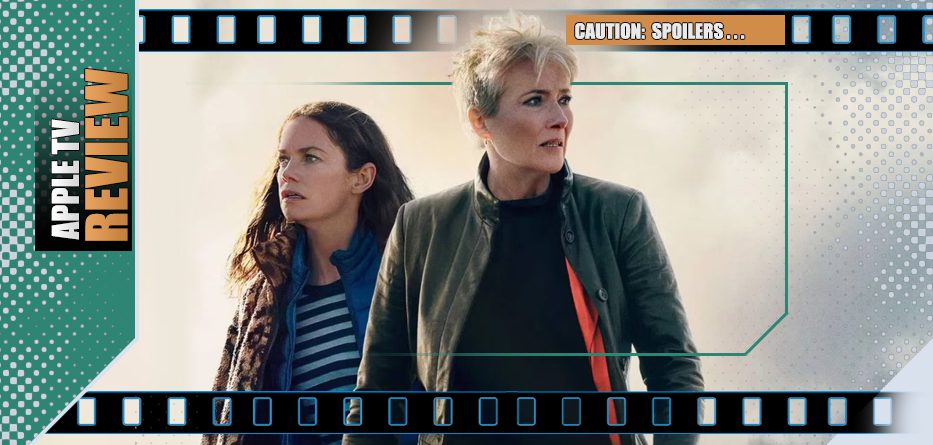
Emma Thompson has had an enviable career. In the beginning she managed to balance being both a favourite of the Shakespearian societies and a key member of Cambridge’s Footlights troupe (which included Stephen Fry, Hugh Laurie, Clive Anderson, Sue Perkins, Peter Cook, Eric Idle and Tim Brooke-Taylor). Through the years she’s embraced musicals, comedy, serious thrillers and become one of the pillars of UK entertainment and established an on-screen persona as someone who can handle anything thrown at her with a certain self-deprecating wit and charm. Here, as private investigator Zoë Boehm, Thompson grounds Zoe as a realist – someone who genuinely cares but tends to keep people at an arm’s distance. She’s compassionate, outwardly cynical yet determined – a role that could have been written specifically for her.
For the record, I could watch Ruth Wilson read a telephone book (ask your parents what they were). She’s become another of the UK’s most reliable and interesting actors, able to essay vulnerability and menace, confusion and intensity in her roles. On stage it’s no surprise to know she’s tackled roles such as Anna Christie (the title role for which she won the Olivier Award for Best Actress), Karin in A Streetcar Named Desire (for which she was nominated for an Olivier Award as Best Supporting Actress) and Hedda Gabler (another nomination for Best Actress from the Oliviers). On television she made her mark as Jane Eyre, the controversial The Affair and in Luther she was (and will still be in the upcoming revival) Alice Morgan, an uneasy, dangerous ally to the titular Idris Elba.
Here her Sarah Trafford is at the opposite end of the spectrum to Morgan or Zoë Boehm. Sarah is an art restorer whose instinctive eye for detail leads her to spotting inconsistencies in the aftermath of a house on her street suddenly exploding. It’s an event that throws her life into chaos, straining her relationship with her unfaithful financier husband Mark (Tom Riley) and leading to her approaching a detective agency to check her doubts. Things continue to spiral and bringing in Emma Thompson’s investigator and agitator starts a growing body count as a governmental cover-up goes dangerously awry. Wilson/Morgan radiates confusion and concern and desperate fury in equal doses, her character is completely un-coordinated and out of her depth, but singularly driven in her mission to find a missing girl that the authorities refuse to say ever existed.
Somehow, Down Cemetery Road manages to be simultaneously a mess and a delight, silly and intriguing, sharper than you expect but at least in-the-moment satisfying. There are plenty of potholes along the way, but the view is fine. Not without fault or pacing issues, it still marks an introduction to a set of characters I’d gladly see return for another run.

- Story8
- Acting8
- Direction8