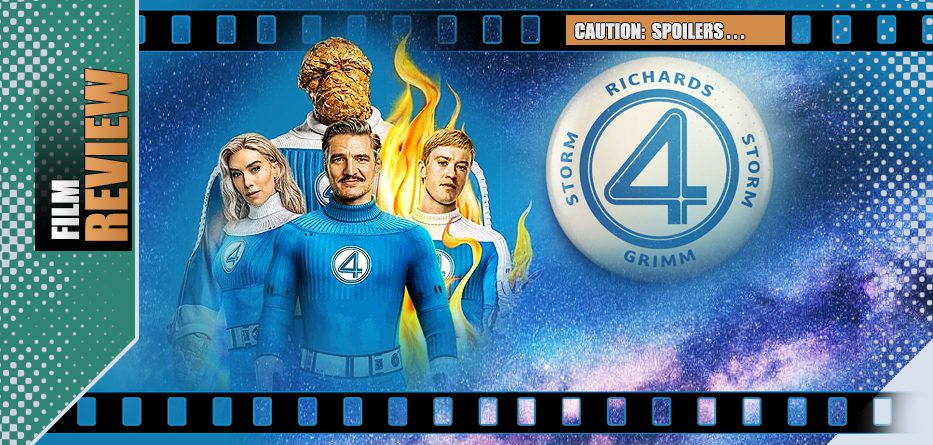
This summer has a fair few ‘blockbusters’ to parse out its schedule, but the two movies that are theoretically going head-to-head are the big superhero outings: Superman and the Fantastic Four. People love to play off the DC vs. Marvel angle, particularly at a time when both studios are trying to course-correct, but it’s fair to say that there’s plenty of room for both to exist in the marketplace. Both have a feel-good factor, but while James Gunn seeks to integrate Clark Kent’s alter-ego into a modern time-frame and importance, Marvel’s offering is the one that arguably does the reverse and takes the audience back to a different time. Sort of.
Is Fantastic Four a throwback to classic superhero derring-do? Well, yes and no. There’s all the bells and whistles of cutting-edge movies to let it compete against modern fare, but, undoubtedly, this is a safer, almost-all-ages adventure and feels far more upbeat, technicolorful and unapologetically positive than the darker and more angst-filled franchises of recent times. Tonally, it’s more a layered version of The Jetsons than the earnest decade-long build of the Avengers. It would be a shame if that criteria alone made it ‘old-fashioned’. Instead, it reflects the selective pseudo-nostalgia for a version of the 1950s that embraces rocket-ships and atomic-themed furniture but sweeps away some of the more obvious and darker inequalities from our point in our timeline. Here – or ‘there’ – on Earth 828, despite the nuclear family and the ‘Gee whizz!‘ atmosphere it appears race and gender-inequalities aren’t an issue, though the existence of the ‘Mole Man’ and his Subterennea beneath the streets of Manhattan hints there’s still some umbridge and grist to be had. But to its credit, this stylised recreation and mix’n’match of pop-culture never descends into parody – it’s a love-letter to a world that’s immediately appealing despite some wrinkles and to which the arrival of a ‘silver surfer’ causes notable waves.
Screen adaptations often struggle to balance the source-material with what is expected from a wider audience sat in a cinema. The thing (no pun intended) is that this is definitely the truest Fantastic Four film from the source material ever made. Throughout every frame there’s a love for both the characters and the world they inhabit. Eschewing the inevitable baggage that nigh on two decades of MCU-world building has involved, this is an entry-point where you can enjoy without having to cross-reference characters and situations (though there’s plenty of easter-eggs for die-hard comic aficionados).
In a reality where 2025 gets ever darker, the summer blockbusters seem to have risen to the challenge of wish-fulfilment, reassurance or at least offer distraction. James Gunn’s Superman shows us the desperate need for empathy and Matt Shakman’s Fantastic Four reminds us of the real priorities. Imperfect in some ways, simplistic in others and perhaps less brow-furrowing than ADD audiences sometimes demand, both movies narratively acknowledge the effort it can take to stand by those principles in challenging times and yet they give flight to our better angels from the silver-surfing screen. Perhaps, box-office be damned, that’s what cinema can always strive to be…
Forgoing the origin story except in brief flashbacks, this is a team that has learned to deal with the changes the cosmic rays brought them and who have started to use those new abilities in ways that benefit society – they already know the great power / great responsibility mantra. Reed and Sue are already married (with her having the Invisible Woman moniker not the Invisible Girl ID that existed between the early 1960s to the mid-1980s on the printed page …and they have Franklin on the way) and there’s no sign (for the most part) of Reed’s less-scrupulous scientific contemporary, Victor Von Doom.
There were plenty of casting suggestions prior to filming (with many liking the idea of John Krasinski teaming with real-life spouse Emily Blunt). Though it’s likely they were considered (with Krasinski having appeared as Reed in Doctor Strange and the Multiverse of Madness) neither he nor Blunt would take up the roles for the team-outing.
Pedro Pascal, everywhere at the moment (and – as per contractual arrangement – once again fighting for fledgling lives) gives us a stoic Reed Richards, smart as a tachyon with scientific principles but barely getting a passing grade in social interaction. Pascal gives us a man stretched between the two, knowing the reality of a dangerous situation and able to voice the most likely logical solution, but human-enough to want to find a better answer at a lesser cost, however less certain. Vanessa Kirby presents a no-nonsense Susan Richards, far from the passive damsel-in-distress, a woman who can vanish from view and project force-fields, but equally able to have a commanding presence and influence in a United Nations-style arena (notably with an absent Latveria diplomat). Joseph Quinn, late of Stranger Things, essays a Johnny Storm that perfectly balances the persona of a ladies-man and happy-go-lucky flyboy, but who also has the brains, talent and heart that would have led him to be part of Reed’s original mission. You totally believe that he’d flirt with an alien one minute and willingly sacrifice himself for his nephew the next, combining the elements that make the comics’ version but which have usually been more streamlined in the film archetype. I’ve always thought Michael Chiklis was inspired casting for Ben Grimm in the Noughties screen efforts, but First Steps‘ Ebon Moss-Bachrach is impressive in that though he remains behind the performance-capture VFX for the most part of the film, the Ben/Thing he gives us totally embodies the character from the printed page and never loses his humanity behind the rubble stubble. Only the voice seems a little off, needing a touch more gravel.
Ozark‘s Julie Garner (soon to be seen in the much-anticipated Weapons) is a sleekier Silver Surfer than previous and much was made of making her the female Shalla-Bal rather than the original male Norrin Radd incarnation. I wish there were a few more scenes with her, particularly between her and Johnny, to smooth the curve over her change of loyalties but this otherworld setting where we can tweak and twist continuity, doesn’t preclude the Radd version appearing later in the main Marvel (616) continuity, though the reason for the current switch seems somewhat arbitrary and doesn’t factor into the story or the character’s ambiguous fate. With all due respect to veteran actor Ralph Ineson, who gives us the frame and words of Galactus, the character is supposed to be a fundamental force of cosmic balance, taking no joy in his world-destroying but having to do so to survive. In that regard, the actor is really buried under prosthetics and comic-honouring VFX, limited to growling a few words of frustration and indifference and so it’s really impossible to grade a performance that could, technically, have been given by any number of actors.
Less complicated than some superhero films and devoid of nihilistic outcomes, Matt Shakman still keeps things moving to the extent that there were, ironically, a few times when I thought ‘Wait, how did that character get from A to B so quickly?‘ but he keeps the heart of the film at the forefront. For all the limitations of a familiar ‘defend the Earth’ situation and a deus ex machina solution (will Reed’s doohickey save the day?) it’s the characters and their efforts that keep us engaged. The film is subtitled ‘First Steps‘ which seems a strange decision given that ‘First Family‘ would have underlined the team’s connective status as Marvel‘s original team and emphasised one of the strong messages of the film – that a group of people who love and care for each other can overcome impossible odds. (Though it’s worth pointing out that when Wanda Maximoff basically said ‘I’ll do anything to find/protect my sons…‘ Marvel turned her into a villain and Sue Richards is very much treated in a more heroic way).
Stay to the end and a mid-season credit sequence (set four years after the film’s events) briefly hints at the arrival of the villain in the next Avengers movie; a final credit acknowledges the debt that the Fantastic Four, the number of this version of Earth and Marvel itself owe to Jack ‘King’ Kirby (an illustrator and talent often obscured by the larger-than-life persona of Stan Lee until the long-standing legal battle for recognition and recompense was won) and then a final sequence updates the form of the animated series FF. Personally, I would have reversed the positions of these extras, but it was nice to see another nod to Kirby during the film where two young men are clearly creating comic-books in a Timely manner.
In a reality where 2025 gets ever darker, the summer blockbusters seem to have risen to the challenge of wish-fulfilment, reassurance or at least offer distraction. James Gunn’s Superman shows us the desperate need for empathy and Matt Shakman’s Fantastic Four reminds us of the real priorities. Imperfect in some ways, simplistic in others and perhaps less brow-furrowing than ADD audiences sometimes demand, both movies narratively acknowledge the effort it can take to stand by those principles in challenging times and yet they give flight to our better angels from the silver-surfing screen. Perhaps, box-office be damned, that’s what cinema can always strive to be…
- Story8
- Acting9
- Direction9
- Production Design / VFX10