It’s the 30th Century and the galaxy is finally re-establishing communication and travel between worlds and star systems after discovering the source of ‘The Burn’, an event that robbed species of faster-than-light travel. As Starfleet attempts to recreate formal relationships between these strange old worlds, it also seeks to recreate its original mandate, not merely to go where no-one has gone before, but to establish common ground. To that end, the decision has been made to relaunch Starfleet Academy and create the first common training grounds for cadets in over a century.
But to do that, there will be high risks and hard choices. Is Nahla Ake really the best choice for Chancellor – even she doesn’t think so? Is Caleb Mir, torn from his mother’s arms a decade earlier and still seething with resentment against Ake and Starfleet really a good choice for the training program? Where will the Academy choose to make its base? Will a disparate class of cadets, who have previously made their own way in the galaxy choose to come together and putting aside their differences?
When an old face from Caleb’s past returns and puts the crew of the Academy’s USS Athena in mortal jeopardy, it seems those choices may have to be made quicker than anyone intended…
*some spoilers*
The basic premise of a show centred on Starfleet cadets has loitered around the fringes of the Star Trek franchise for several decades. Though there have been variations on the specific theme offered up for consideration (ranging from comedic hijinks through to more serious fare), none ever saw the light of day, with many a loyal fan offering up a silent Vulcan prayer of thanks, less the result had reflected their lack of great expectations.
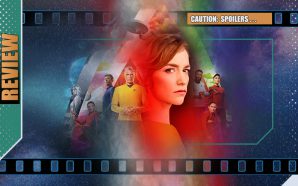
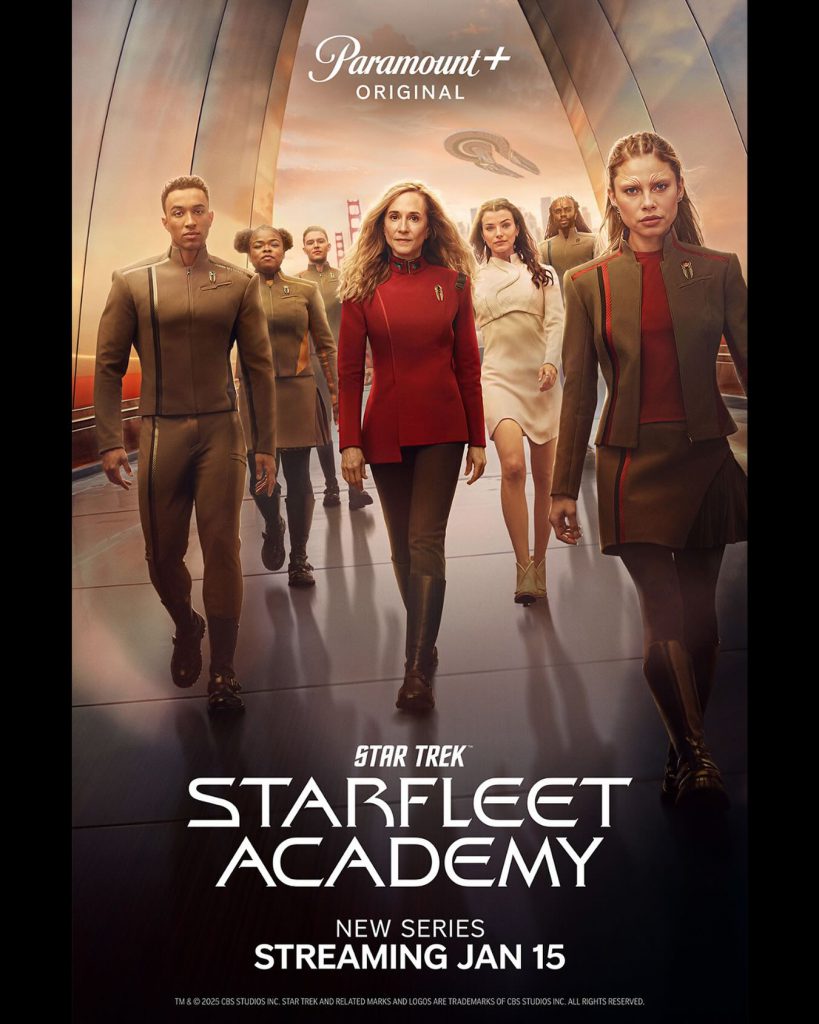
So, when the official news came last year that a Starfleet Academy show would launch in 2026, just as Trek celebrated its 60th anniversary, the reaction was… mixed. The decision that it would be set in the far-future 30th century where we left the marmite and time-displaced Star Trek: Discovery did nothing to quell concerns and when a promotional poster hit the interwebs late last year, see above, there was a notable disturbance in the Force (okay…wrong franchise, but correct sentiment) that this would be a show more at home in the ‘golden’ days of America’s youth-trending The CW than Paramount+. More 90210 than 2010. More extra-curricular than extra-terrestrial…. well, you get the idea.
 There’s a plaque in a classroom I know that states ‘The leaders of tomorrow are in this classroom today‘, a maxim that can spark pride or fear depending on the day it’s read and who is in the room at the time. It feels a similar situation reviewing Starfleet Academy…with its two episode launch this week, does it fare better than those misgivings?
The opener, Kids These Days, is perhaps a little darker than expected and settles on providing the most backstory for Sandro Rosta’s rebellious Caleb Mir. Almost literally ripped from his mother’s arms (She-Hulk‘s Tatiana Maslany as Anisha Mir) after she makes an ill-fated deal with ‘space pirate’ Nus Braka (Paul Giamatti) he hasn’t had the best of starts. Despite extenuating circumstances, Anisha is imprisoned and later vanishes and has been AWOL since. The young Caleb escaped Star Fleet custody and has been on the run for over a decade, hoping to be reunited with his mother. We will see the efforts of Star Fleet – to reboot its Federation remit and produce its Academy’s first new recruits for decades – mostly through Caleb’s eyes.
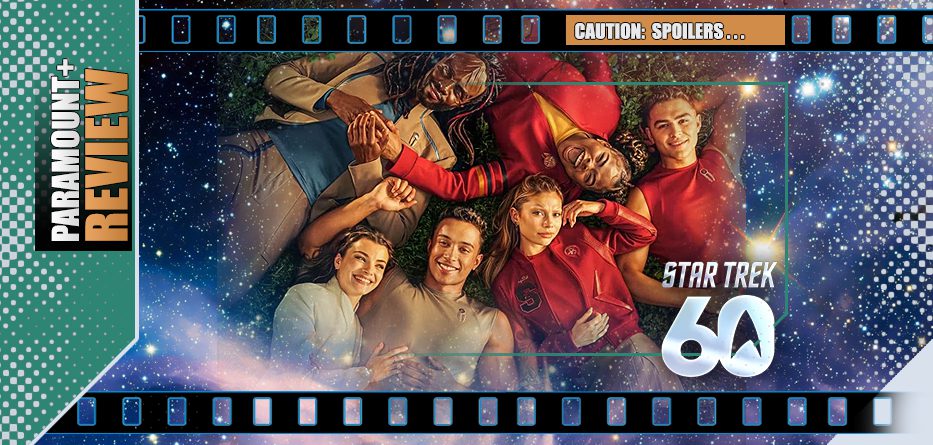
Caleb, played as a young adult by Sandro Rosta, will likely be a divisive character. For the younger audience he’s designed to prove a catnip and perfect-complexioned anarchic flyboy with an eye for the ladies, but for older audiences he’s simply a warts-and-all, smart-mouthed kid who gets away with far too much and needs far more consequences to his actions. The other main cadet characters are Karim Diane as unusually zen-lite Klingon Jay-Den Kraag, George Hawkins as the entitled Darem Reymi, Bella Shepard as Genesis Lythe (the daughter of a Starfleet general who is smart and resourceful and perhaps too perfect) and SAM, who we soon learn is actually an over-enthusiastic holographic-life-form played by Kerrice Brooks. They are all Starfleet cadets but there’s another regular character, joining in the second episode, a self-aware Betazoid called Tarima Sadal (Australian actor Zoë Steiner), daughter of a previously-isolationist diplomat who’s making the most of spreading her wings and joins the parallel ‘War College’, setting up some love-triangle diversions.
Starfleet Academy provides plenty to enjoy on a basic level and revels in its innate nostalgia and easter eggs a’plenty, but it’s far too early to tell whether (the show) is an entry of huge distinction or just mass distraction… and we made need to see a full semester to tell if it makes the grade purely on its own merits rather than just leaning into its lineage…
For the older, veteran casting, Holly Hunter is an interesting choice for the main ‘command’ role, Nahla Ake… reluctantly returning to the formal Academy to command the USS Athena and as the Academy’s Chancellor after past decisions (including her treatment of Caleb) and institutional restrictions led to her continuing her long life-span away from formality. (Though she looks human she’s actually a Human/Lanthanite sharing characteristics with SNW‘s Pelia (Carol Kane) that include a good timeline in snark and thumbing her nose at pomposity). It’s one of those dual responsibility/roles that’s loosely written enough to accommodate whatever situation arises each episode, rather than being wholly logical, but Hunter’s dismissive southern drawl paves over a lot of the narrative seams. However, purists may seethe at her physical disrespect for the command chair, in which she simply curls up as if ready to read a good book!
Veteran Paul Giamatti, one of the best actors out there and a long time sf fan, relishes his entry into the echelons of Trek villains and positively chews the entire scenery as the insidious space-pirate Nus Braka with a boo-hiss arc that will likely extend the whole series or beyond. It’s cool to have such a name attached and if it’s played with the broadest of strokes, then you just have to sit back and enjoy.
The rest of the adult cast know what they’re doing from the outset. Robert Picardo returns as ‘The Doctor’ (the holographic character from Voyager, not the Gallifreyan variety), Oded Fehr reprises his Discovery character, Starfleet Admiral Charles Vance and Tig Nataro as Jett Reno brings back the engaging engineering snark to a teaching role… all of them slipping into comfortable shoes and characters they know well. New to the Trek universe, British writer and comedian Gina Yashere plays Commander Luna Thok, the hard-driving Cadet Master of Starfleet Academy. She’s a hybrid Klingon/Jem’Hadar which does feel a little like the writers’ room rolled the dice and picked two unlikely species to combine for the heck of it. Listen closely and you’ll hear, rather than see, Another Earth/OE star Brit Marling as the voice of the USS Athena computer and no less than the great Stephen Colbert as Starfleet Academy’s Digital Dean of Students.
For long-term fans, the show has fun with the different arms, or tentacles, of Trek to date. Beyond the Voyager and Discovery actors, there’s a ‘wall of honor’ and academic ‘wings’ providing name-checks for a multitude of familiar crew-members from across time and space. There’s production-design nods to TOS, The Next Generation and Voyager (confirmation that Harry Kim finally got promoted!). Watch out for a Rok-Tahk-esque character from the animated Star Trek: Prodigy strolling around. Hey… there’s even some whales! Whether fan-service or lip-service, it’s all in good fun and can add a little depth to proceedings without making newcomers feeling adrift. Either that or it’s all merely sparkly decoration designed to divert from a rather familiar set-up.
The second episode Beta-Test, certainly gives off a feeling that the show could be more than leaning heavily into a Hogwarts-in-Space template with an array of shenanigans and teachable moments. Yes, its star-crossed developments clashing with diplomatic relations feels more like early Next Generation fare than anything else.
Some will talk of the wider ‘swings’ that the Trek franchise has been trying over recent years, hoping to continue its once-assured dominance by alternating its classic lore and new trends. Yes, Strange New Worlds gives the pre-TOS era a wash-and-brush-up, the animated Prodigy and Lower Decks were drawn to humour and Picard may have partially-satiated the TNG faithful… but at best it’s a law of physics and diminishing returns if you go to the existing space-well too many times and all of the above are now off-the-air or will soon boldly go into reruns. From its two episodes so far, Starfleet Academy feels genetically designed to appeal to the widest possible audience and tilt towards all the current windmills, though that decision could still see it flounder if it seeks breadth over depth. (The third episode looks set to show inter-department sports competitions and pranks, so how long before we have a DumbleWorf declaring ‘Ten points Tribblepuff?“).
But, listen… I’m long over the silly, knee-jerk criticism of modern Trek being ‘woke’ (a critique which speaks to planet-sized ignorance – especially for a culturally-significant franchise that’s has purposely featured welcome inclusivity, diversity and fundamental moral questions since the 1960s and inspired real-life success). However, there’s no denying that in fulfilling its next, next, next (etc.) generation remit of different planetary societies pulling together after the cataclysmic and isolating ‘Burn’, there does seem to be a range of overt representation that sometimes teeters close to being a safety-net checklist of tropes. To slightly appropriate Herman’s Hermits, it’s “Second ‘verse, same as the first…”
The attempt to provide something for everyone could be satisfying or its own worst enemy and it’s hard to imagine that Starfleet Academy, entertaining enough in the moment, will ultimately resonate down the decades. That being said, older fans have to realise that the franchise, like – say – Doctor Who, has to regenerate over time to include an incoming younger audience and sometimes have a style that isn’t intended to satiate the existing longer-term viewers. The show provides plenty to enjoy on a basic level and revels in its innate nostalgia and easter-eggs a’plenty, but it’s far too early to tell whether Starfleet Academy is an entry of huge distinction or just mass distraction… and we made need to see a full semester to tell if it makes the grade purely on its own merits rather than just leaning into its lineage…
- Story7
- Acting7
- Direction7
- Production Design / VFX8