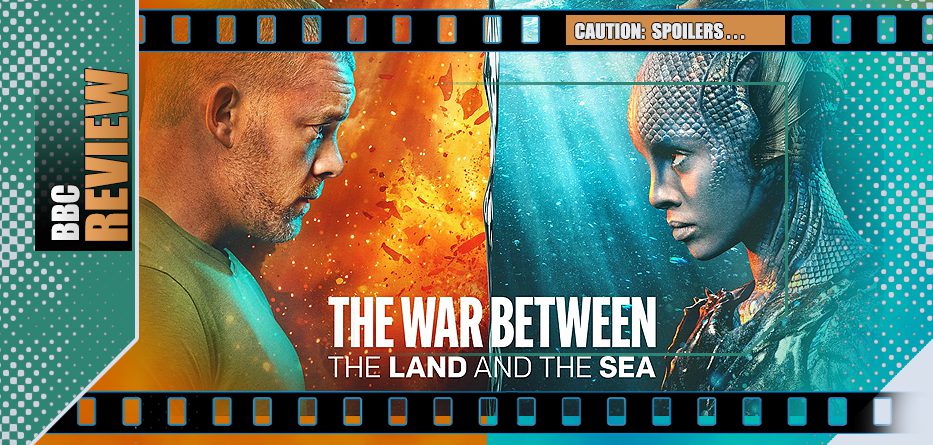
A trawler at sea accidentally catches and kills a life-form that is definitely not the typical fish they were expecting. Ever-vigilant, the Unified Intelligence Taskforce (UNIT) realises the implications and attempts to find answers. UNIT’s work with The Doctor has made them well-aware of the creatures that share this universe and this planet, but they know that this time, things might be different.
Now creatures once branded as ‘Sea Devils’ have decided that enough is enough. It becomes clear that ‘Homo Aqua’ are demanding not just reparation but an immediate stop to the pollution and behaviour that has damaged their home. They might be prepared to share the planet, but only under new formalities. They send an ambassador named Salt to confront the surface-dwellers, but things become complicated when it turns out that the human, Barclay, whom they want to be their opposite number in the negotiations, has actually been seconded there quite by accident – he’s the guy who usually handles paperwork and transport.
With the weight of the world possibly in the hands of Barclay and Salt rather than governments and businessmen – and no Doctor to swoop in to save the day – history is destined to be made, but not everyone wants the negotiations and compromises to go well…
*spoilers*
*SEE UPDATED REVIEW FURTHER BELOW FOR FULL SEASON REVIEW*
The success of The War Between the Land and the Sea or ‘TWBTLATS ‘(a descriptive title so long, even the acronym feels a bit unwieldly) may well depend on your expectations. Certainly, the sweeping vistas and the production design of the first two episodes indicate that televisual time and money have been spent on this Time-Lord-adjacent but standalone tale, so it’s all down to the telling. Launching with a double-bill on a Sunday night sets out its intent and credentials – it’s not really Christmas Day material and it’s not quite Saturday primetime, but with a Sunday schedule-domination definitely worthy of note – it’s technically something within the Whoniverse but standing just a little off.
One wants to judge the mini-series purely on its own merits, but the Whoniverse has had so much turbulence of late that it’s not entirely possible to do so cleanly. Rather than achieving new heights or pushing boundaries, it seems that Russell T Davies’ mission statement is to, quite deliberately, cast his narrative net as wide as possible without losing his core catch. In that sense he succeeds: there’s a little of something for everyone here: for long-term Whovians (there’s definitely a feel of the older, classic series being given a wash-and-brush-up), for more casual, modern mainstream viewers (those that tune in to see what’s going on and doesn’t want to plough through years of continuity) but also an opportunity to deal with weightier issues that can’t be resolved in 50 minutes (there’s a – literal – deeper dive into environmental aspects that don’t offer easy, immediate solutions).
With The War Between the Land and the Sea, it doesn’t seem as if Russell T Davies is seeking out new heights or attempting to push new boundaries, it’s more a case of slowing things down, taking the lay of the land (and the sea) and then casting his narrative net as wide as possible within a specific subject-matter. This is Davies without his thumb pressed firmly on fast-forward – producing not so much a course-correction but perhaps a more nuanced story and a calculated opportunity to attract those less enamoured with the looser tone and format of the ‘mothership’. On that level, he probably achieves the intended result…
Though you will have to watch the entire five episode run to assess the over-all tone, the two episodes work intro pretty well in finding the pragmatic middle-ground between the mainstream, speed-along, one-story per week pace Doctor Who and, say, the critically-acclaimed (and very dark) Torchwood mini-series Children of Earth – another story about diplomatic relations and conspiracies gone awry with a far darker, even nihilistic outlook. It’s easy to preach about general lack of due planetary care, but it is harder to tell from the opening two episodes where Davies will ultimately take his story (I predict now that even amongst the overt lessons of tolerance and environmental care, we’ll have a denouement that won’t require CoE‘s potential full-on child-sacrifice territory this time!). On one hand, it’s clear that humanity is on the moral back foot, rightly being chastised for its rubbishing of the Earth and it’s easy to side with ‘Homo Aqua’ about the stretched limits to their tolerance. We’ve seen different factions and duplicitous plans going on in the surface world, but one suspects that to make this more complex and less one-sided, there may have to be a few wrinkles beneath the waves with which Salt will have to contend.
The casting is solid. Both Russell Tovey (as Barclay) and Gugu Mbatha-Raw (as Salt) have appeared in Doctor Who as other characters, but they quickly assume their new pivotal roles. (In about the only mention of the Time Lord, Barclay reminisces about briefly meeting him in a UNIT hallway but notes that it changed his perspective on life). Mbatha-Raw emerges from under carefully-designed thin-cyan-hued prosthetics that don’t make her look too alien, but in these first episodes it’s Tovey who anchors it all, instantly relatable as an apparently unassuming everyman he’s accidentally dragged into historical events. Jemma Redgrave as Kate Lethbridge-Stewart, Ruth Madeley as Shirley Anne Bingham and Alexander Devrient as Colonel Christofer Ibrahim also reprise their roles, though Kate’s demeanor feels far more authoritarian now that the Doctor isn’t around.
Indeed, if this is a Doctor-less show, then it’s interesting how it uses UNIT. The Time Lord has had a mixed time with the military force over the years – close friendships with the Brigadier, his daughter (and current chief) Kate and various soldiers and officers not withstanding, he’s been wary of people too eager to carry guns and solve problems through firepower. Over the years the taskforce has been seen in various shades, some more positive than others, but TWBTLATS manages to make them a mixed bunch of good-intentioned, pragmatic reactions and human foibles. It’s another chance to see how they operate without Gallifreyan oversight.
VFX-wise it’s all pretty shiny, though the shadow cast by James Cameron’s 1989 ground-breaking The Abyss (especially the extended version where we see a montage of the potential for conflict and destruction between the world above and the aquatic civilization that Ed Harris and Mary Elizabeth Mastrantonio discover) still remains a long one. Even adjusting for inflation, Bad Wolf doesn’t have a fraction of that budget and it keeps most of its early plot above the surface. What it does have it uses well enough alternating between the intended mundane situations (Barclay’s personal life is a balancing act) and the more eye-catching (the air/sea-lock constructed for the first ‘diplomatic’ meeting drawing on CoE designs but on a more wide-view scale).
The financial input of Disney is all on show, but the recent BBC/Disney split means that international viewers unable to access UK programmes or the BBC iPlayer or unwilling to use a VPN won’t be able to see the mini-series until early next year (Disney+ hasn’t specified the airdate). It seems likely that die-hard fans will have found a way to see it before then, so expect Disney+ ratings to be less than stellar on official broadcast.
With The War Between the Land and the Sea, it doesn’t seem as if Russell T Davies is seeking out new heights or attempting to push new boundaries, it’s more a case of slowing things down, taking a breath, getting the lay of the land (and the sea) and then casting his narrative net as wide as possible within a specific subject-matter. This isn’t a ‘fix’ because though it was legitimately divisive, plenty of people did like the recent Doctor Who run. However, this is RTD without his thumb pressed firmly on fast-forward – producing not so much a course-correction but a more nuanced story and a calculated opportunity to attract those less enamoured with the looser tone and format of the ‘mothership’.
On that level, he probably achieves the intended result. It has potential and we’ll see how the way it plays out affects the future of the Whoniverse…
UPDATE (21st Dec):
As the tide went out on the final instalment of the five episode mini-series, how did it all fare?
While Doctor Who speeds along, sometimes at the glossy detriment of development and depth, the opposite seems true for The War between the Land and the Sea. Certainly better than the recent run of Doctor Who but falling short of Children of Earth‘s darker and more dynamic telling, this latest mini-series seems in no rush to tell its story and by the time the credits finish rolling, there’s the feeling that it’s a story that might have been strip-mined and detrimentally squeezed into a standard episode, but probably best-suited to a two or three-parter.
It’s a decent mini-series and placeholder, a welcome chance to let UNIT move centre-stage, but there were still several problems that are worth noting.
For a story about conflict between species, it’s pretty one-sided in presentation – there is not a lot of time spent with Homo Aqua. Excepting Salt and a few representatives that come to the giant tank for diplomatic negotiations, the rest of the sea-faring species are largely reduced to long-distance shots or (in the final episode) floating bodies and collateral damage.
Gugu Mbatha-Raw is good as Salt but is ultimately hampered by a lack of individual character development as the story continues. At the start she’s a dynamic and not-to-be-messed-with representative of her species and there’s an interesting development in the revelation that she can shift between female and male characteristics. But come the mid-way mark and right until the final denouement Salt then becomes little more than a damsel in distress, apparently smitten with Barclay. Later scenes above the surface also show the limitations of the costume/prosthetics. (To be fair, even with a huge budget James Cameron’s underwater empire also looked less impressive when it rose above the waves).
A RTD favourite, Russell Tovey proves his acting chops yet again, but it’s Jemma Redgrave’s performance that will likely be just as remembered – showing a spine of steel and nerve that she often doesn’t get to show when the Doctor’s around. Her PTSD, pill-taking and a deliberately unnerving encounter with a beach-side litterer amid the closing credits bode well for follow-up whenever there are future Who-related projects. (Though RTD touting the scene ahead of broadcast to his usual bombastic level mayhaps didn’t help).
The villains of the piece are nefarious, duplicitous and cowardly – and human (there’s no real slights-of-fin from our aquatic characters), but we really don’t get an idea of their plans until the final episode. They are boo-hiss baddies but throwaway threats – like lightweight versions of the compromised characters in Children of Earth, but far less developed. (Peter Capaldi’s CoE John Frobisher is more memorable in a handful of scenes there than Vincent Franklin’s spineless PM Harry Shaw in TWBTLATS).
We’re left with a world that’s secretly used morally abhorrent weapons to win a war but left a world that must now be aware that they share the planet with another intelligent species that has rights. Little is also made of the story-point that the world’s ice-caps have been seriously-depleted in an act of Home Aqua’s desperation and therefore the world must have massive, historical, nation-affecting flooding, but there’s no mention of that and its implications thereafter.
Fandom’s speculation can often be a precursor to inevitable disappointment, but as a story about mankind’s ambivalence to the planet and the environment, this a good enough tale, easy to enjoy in the moment but – as with many RTD ventures – the moments of smart, sardonic and heartfelt introspection are balanced by hand-wavery, non-dot-joining scenes that should be just as important but are not really addressed. It’s a one-sided mini-series that could have been down-sized to make its salient points or expanded to feel more nuanced, but as pure entertainment it’s easy to recommend as long as you adjust your expectations accordingly. Reminiscent of Marvel‘s Secret Invasion, the ideas that motivate it are excellent, yet the execution leaves a few too many gaps to be as ‘epic’ as promised.
Technically, it could and indeed should change the Whoniverse, otherwise it loses all import, but if it’s still sometime before Who returns in any regular form, it may lean more into the illusion of change rather than change itself.
- Story8
- Acting8
- Direction8
- Production Design / VFX8