The Allies have won World War II, but can they win the peace by holding the people behind the global atrocities to account? To do so involves creating an entirely new framework to cover the scale of evil deeds and the need to be transparent in front of a world that is watching every detail. With the decision to hold a massive court proceeding in Nuremberg, Germany, the Allied Forces look to international co-operation above singular agendas and to that end they bring in a range of legal and medical talent to assess the prisoners they intend to try.
Either through his own hubris or simply not caring about the cost, one of Hitler’s most senior officials, Hermann Göring expects to escape confinement but is quickly captured and taken to Nuremberg. A man as confident as he is ruthless, will he be able to escape the justice that the world commands? A psychiatrist named Douglas Kelley is brought in to analyse Göring ahead of proceedings and realises that his observations may hold the key to the outcome…
*spoilers*
The Nuremberg Trials, run by the International Military Tribunal between 1945-1946, attempted to bring the people responsible for the genocide and war-crimes of WWII to account on a precedent-setting legal stage. Despite of – or perhaps because of – the determination to make those in charge pay for their atrocities, there was much to decide before and during the trials of senior Nazis. Such events are as rich in drama as they are in tragedy and that means they are enticing elements to recount. So, it’s no surprise that they have been portrayed on screen many times to varying effect.
The problems with any historical drama (especially one that isn’t claiming to be a documentary) is what you accurately include, what you leave out and what you change. A two-hour movie on anything of magnitude will likely truncate events to make sure it covers the basics. It’s also a general Hollywood maxim that a film needs a central character through which to guide the audience along its narrative. Real-life elements are often abbreviated, combined or skewed to fit the momentum needed with a carefully-worded, small-print disclaimer attached.
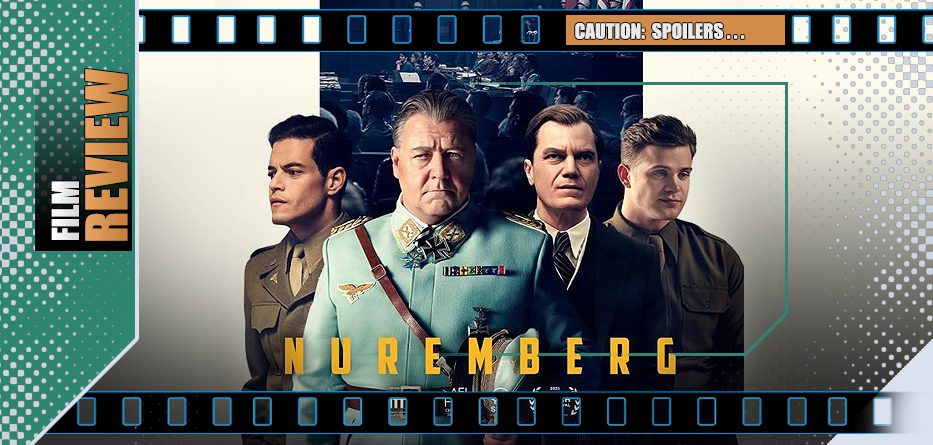
The truth of the matter here is that army psychiatrist Douglas Kelley (here in the form of Rami Malek) is not only that pair of guiding eyes, but the central character of the 2013 book The Nazi and the Psychiatrist by Jack El-Hai on which the film is based. To its credit, the film makes Kelley smart, a charmer and driven professionally but also a flawed man, one who embraces the opportunity of getting face to face with ‘evil’ more as a way of discovering enough insights to write a (hopefully best-selling) book about the motives of men responsible for historical levels of genocide. He’s deeply affected by his conversations with Hermann Göring (Russell Crowe) who is portrayed as a deeply manipulative but confident man who is tolerating his imprisonment only as an opportunity to take the right moment to further push the Nazi rhetoric in front of the millions who will follow the trial. Much of the film revolves around the power-play between them – and therein the film finds its hook.
We see Kelley compromise himself in an effort to understand Göring but also the pressure of not letting him get away on a technicality. In real life, Kelley – originally hired to establish the accused’s competency to face judgement – was long gone by the time Göring and his gang of Nazis actually entered the dock, but the film invents a ‘Road to Damascus’ moment where Kelley actually sticks around to help the Allies avoid the prosecutorial traps the Nazi general has laid.
Over half the film is carefully laying the groundwork for the trial – looking at the competing agendas of all involved in a legal event that would set so many precedents for dealing with those accused of international war crimes. Those wanting the ebb-and-flow of courtroom tensions have to wait a while but get there eventually and though it doesn’t reach the levels of the Jack Nicholson / Tom Cruise stand-off at the end of A Few Good Men, Crowe in particular rises to the challenge of portraying a man who doesn’t recognise the authority for which he has been incarcerated and for whom the trial is a mere annoyance likely doomed to failure. Crowe has always been an enigmatic actor. The rough-and-ready Kiwi carries a Richard Burton-esque swagger and the essence of a man who has thunder behind his eyes and deeds in mind, but has proven equally capable of a diverse range of roles that defy easy ‘leading man / action hero’ labelling. Assuming the role of Göring requires someone can own a room the same way that Jack Nicholson (A Few Good Men) or Anthony Hopkins (Silence of the Lambs) could command and Crowe – sure to get some award nominations – positively glowers with serpentine confidence to the last. Rightly, you are never asked to like Göring or even sympathise with him, but there is an enticement to understand why he thinks and acts the way he does.
In an industry that likes templates and interchangeable performers, Rami Malek’s has also been intriguing in his roles to date including Elliot Alderson in the surreal cult series Mr. Robot and Freddie Mercury in Bohemian Rhapsody. His unique, ever-inquiring face often beings us characters that are hard to pin down. There’s a feeling here that there isn’t thunder behind Malek’s eyes so much as a really annoying algebra problem. But that drive to know the unknowable is what drives the character of Kelley from the outset. The psychiatrist never quite evolves out of the need to be recognised, lauded (and profit) for his research, but his understanding of the danger Göring invokes also grows and directs his journey and proves key in finding Göring’s weaknesses.
The likes of Michael Shannon as American Justice Robert H. Jackson (aware of how much pressure a conviction and justice is needed, even at personal cost), Richard E. Grant’s Sir David Maxwell-Fyfe (the UK representative at the trials), Mad Men and The Rainmaker‘s John Slattery as Colonel Burton Andrus and Colin Hanks as Kelley’s rival Dr. Gustave Gilbert all play significant, pivotal and effective parts.
James Vanderbilt, best known as a writer on the likes of Scream, The Amazing Spider-man, White House Down and Zodiac rather than a director, foregoes big set-pieces and much of the film is about personal relationships and setting up a powerhouse procedural – though by the time it gets to the courtroom scenes (intense though they may be) the audience may be left wanting more than they get. More ‘glossy’ than needed, the film does manage to convey the importance of what we’re seeing and the ‘perhaps controversial/perhaps necessity’ of using real footage of the liberation of the concentration camps (complete with skeletal survivors and pyres of burning corpses) will make you catch your breath.
There are several moments in the film that trace Hitler and Göring’s rise to power and question how they could wreak so much damage so quickly – providing both historical commentary (how Germany and its citizens reacted to their defeat during the First World War and the restrictions placed on its populace) and to the moral disbelief that a holocaust could happen without the world immediately knowing of the depravity of the ‘Final Solution’. (Göring’s defense is that he can’t be held responsible for events that he wasn’t actively there for). It is impossible to take note of the scenes where people talk of ensuring ‘this never happens again’ and the insidious way that patriotic pride can be turned into an oppressive cudgel with which to crush all dissent… and not draw some parallels with how history has learned little from it. Wherever you stand politically in real-life, the modern populace now seems to be less than shocked hearing of people being disappeared, calls for opposition to be locked up (or worse) and for the egos of politicians to rise to unprecedented bravado. Godwin’s Law (comparing anything to Nazis usually being an argument-ending position) aside, there’s undeniably a parallel to be seen.
The landmark 1961 film, Judgment at Nuremberg and the critically-acclaimed two-part Canadian/American television docudrama (also ‘Nuremberg‘) broadcast in 2000 (featuring Brian Cox as Göring) both cast a long shadow film and this latest 2025 venture is solid enough if not as truly ‘great’ as it could have been. It finishes with acknowledging the fates of both Göring and Kelley and with a quote from R G Collingwood, reading “The only clue to what man can do is what man has done…“, underlining aspects of the film and the events it depicts as warning bells to time.
Nuremberg can be seen theatrically in the UK and on streaming platforms such as Netflix and Prime Video in the US and internationally…
- Story8
- Direction9
- Acting9
- Production Design / VFX9